
Written by Simran (Class of 2026)
Bihar, one of the poorest states in India, faces severe flooding every year that leads to economic instability, social marginalisation, unsustainable urbanisation, the disappearance of Indigenous cultures and ecological diversity, and increasingly extreme climatic conditions due to climate change. However, Bihar still has a chance to shift towards models of sustainable development and regenerative practices.
At the Centre of Resilience, founded by Prashant, he and his team work to address these intersecting issues on a regional scale by hiring and training low-income workers to earn a living in ways that regenerate the land, challenge social barriers, and demonstrate the power of sustainable and accessible solutions. It is conceived and built to respond to the needs of the people, land, and water of Bihar.
In 2017–18, Prashant Kumar, an Indian social artist and activist, started working on the Bihar Project, a model for resilient housing, from the ground up. The team comprised almost entirely local people—men and women who are mostly Indigenous farmers. These are people whose everyday lives are grounded in real experiences, which enables them to better understand the needs of the local area. To battle this crisis, the Resilient Floating Housing Project was initiated by the centre in 2019. It represents the first step towards creating independent floating communities in India. The project aims to address the issue of displaced native farmers by providing them with skills training and the opportunity to maintain their traditional sustainable way of life. It is a direct response to the growing impact of climate change-induced flooding, not just in Bihar but in various parts of the world.
About the Centre of Resilience
The aim of the project is to tackle the intricate problems of climate injustice and systemic marginalisation by adopting new and creative methods. Although there are existing housing models that can withstand floods, none adequately address interconnected issues such as environmental impact and cost-effectiveness while also providing sustainable and long-lasting solutions. Therefore, their main goal is to create a prototype for affordable, modular, scalable, and self-sufficient floating housing.
At MUWCI, every first-year student spends a week in their respective Project Week placements and works with NGOs across India to understand how they operate and gain hands-on experience. I was part of the Centre of Resilience. We spent a week at Prashant’s house and built a hut using sustainable materials.
Aim of Our Project
“Building a Sustainable Hut Using Low-Tech Equipment” and understanding how the floating house was designed and constructed, and with what materials.
After reaching Patna airport on Sunday evening, we were picked up by Prashant and reached his house at night. The next day, after breakfast, we went to his workshop and planned our week. Our primary task was to design a hut, and we began by sketching it out using chalk. During the discussion, we considered design elements such as the shape of the windows, doors, and roof. Later, we reviewed samples created by third-years, along with various artworks that showcased different architectural styles they had made and painted.
Once the design was finalised, we divided ourselves into three teams: one for cutting the bamboo, another for digging the holes, and a third for artwork. I was in the digging team, where we prepared the foundation for the hut.
We started by cleaning the ground and making it flat by cutting down unwanted plants. Everyone was using these tools for the first time, and many of us got hurt. However, we managed to continue and dug nine holes—eight on the sides and one in the middle to maintain balance. Meanwhile, the other team was cutting and smoothing the bamboo. It took an entire day to complete this work. All the bamboo poles were measured equally and properly placed into the holes. We then used bricks to strengthen the base.
Before placing the bamboo, it was painted at the bottom because bamboo is naturally susceptible to rot and decay when exposed to moisture. Painting creates a protective layer that prevents water from penetrating it directly, thereby extending its lifespan. We completed all this work in two days.
The best part was the food because it was homemade local Bihari food. We used leaf plates, which are biodegradable. Every afternoon after work, we had lunch, which motivated us to continue learning and working. The informal talks during lunch about the village gave us insight into the area and the living conditions there. One evening, we discussed the lives of people living in slums. Prashant explained the economic disparity and how people earn their living. For example, many fish from the river in front of their homes, even though it is very polluted. Hearing about their struggles for a single meal and for their children made our purpose stronger.
Wall Construction
We began working on the walls using thatch grass, which provides excellent insulation and helps maintain a comfortable interior temperature. The grass fibres trap air, acting as a natural barrier to temperature differences, keeping the hut cool in hot weather and warm in cooler conditions. We constructed three large walls and secured them across the bamboo frame.
Next, we worked on creating the roof, which was designed with a rounded shape. To ensure stability and strength, we layered multiple sections of bamboo and secured them with wire, and later nailed them in place. This process took nearly half a day. After completing the structure, we put up the walls and covered the roof with thatch grass.
We then plastered the walls and door. To make the plaster mixture, we used fresh cow dung, mud, calcium oxide, and jaggery water. These materials have a long-standing tradition in rural and traditional building practices in India, and each has its own advantages. Cow dung prevents fungal and bacterial growth. Mud acts as a binder. Calcium oxide (quicklime) helps the mixture harden over time. Jaggery water increases the plasticity of the mixture, making it easier to spread and smooth. All these materials are available at a much lower cost, which is another reason for using them.
After thoroughly mixing the plaster for an hour, we applied it to both sides of the walls and the door frame. The door shape was also formed using this mixture. Initially, touching cow dung felt unpleasant, but later it became comfortable because we were focused on completing our hut well. After plastering, the hut was left to dry and strengthen for a day. We also learned how to make Vedic bricks used in the construction of the floating house.
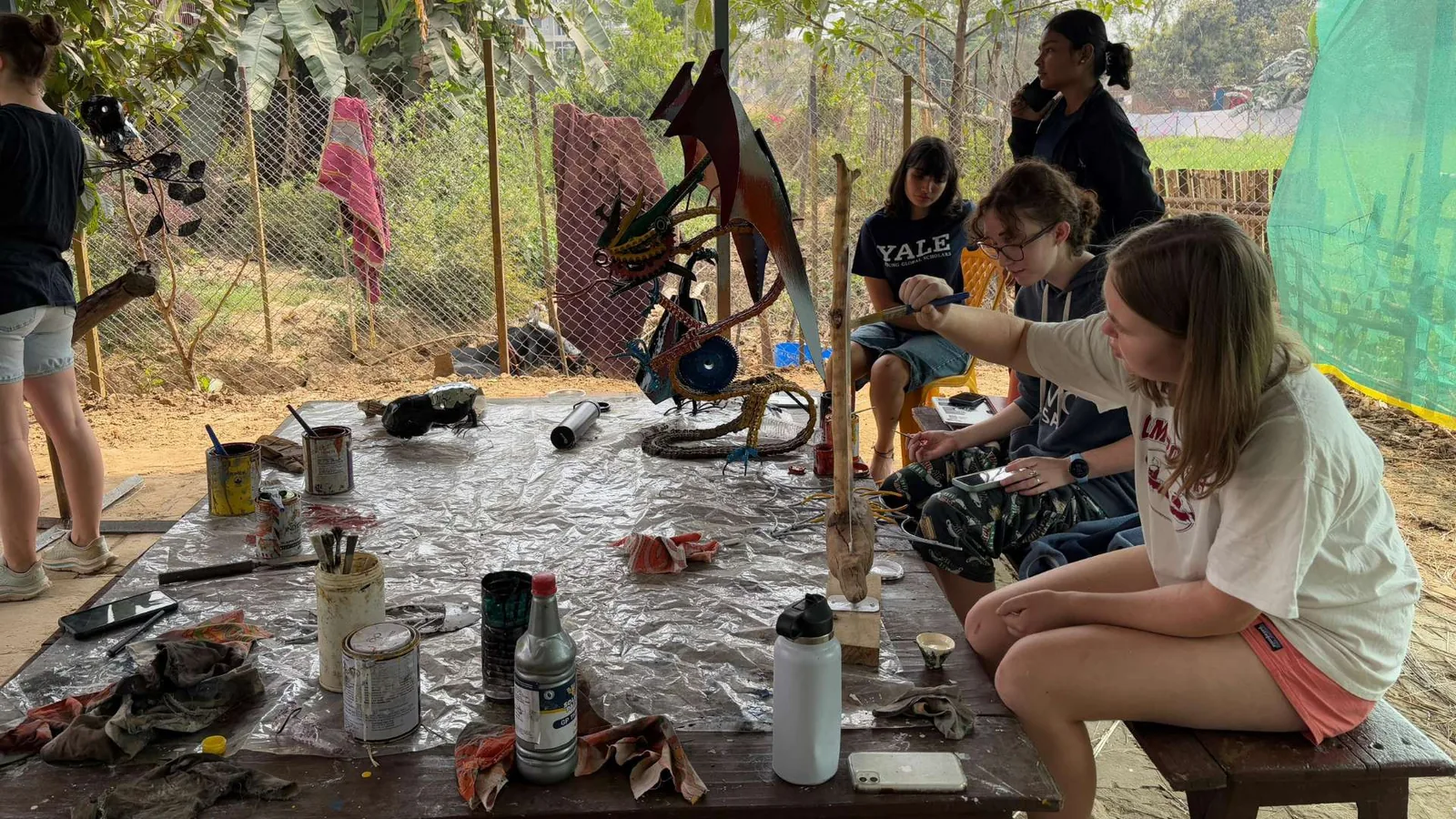
Apart from constructing the hut, another team worked on upcycling artwork. They painted objects made from recycled materials and gave them new life—for example, owls, peacocks, trees, and lamps made from old bike chains. Although there were occasional conflicts about task distribution, we eventually divided the work equally and switched tasks halfway through the day so that everyone contributed to both areas.
I believe the destination is not as important as the process of reaching it. Throughout this journey, I learned a lot about my batchmates and bonded with them in ways I would not have on campus. The fun, experiences, learnings, and connections added immense value to this project and gave us hands-on experience. Seeing the slums and economic disparities made me reflect deeply on my purpose in life and how I can contribute to society.
Learnings
I learned the importance of stepping out of my comfort zone, appreciating nature, respecting it, and giving back in every possible way.
Prashant’s story inspired me deeply. His decision to take a bold step for his community and build floating houses with dedicated people showed me that meaningful change does not always have to happen immediately.
Like Bihar, many other places need educated and enthusiastic people who are willing to contribute positively. I also learned a lot about myself and discovered new interests and strengths.
Challenges
Living away from the comfort of MUWCI was very different. Prashant’s small house was built using low-tech methods. We slept on the floor with mosquito nets, which was a new experience, though we struggled with mosquito bites. Taking cold showers at night was something we were not used to. However, we adapted to the situation because we knew we were there for a purpose. Over time, everyone became more comfortable with the challenges and even willing to work longer hours.
On the fifth day, after packing and cleaning the area, we visited the floating house, which completed our journey.
The floating house is on the Ganga River. Seeing it sparked hope in me. I wondered how it floats and stays stable. Prashant explained that they used 108 plastic drums to keep it afloat. The house was tested for two years and withstood multiple challenges. The next goal is to work towards building a floating village, which will take time but could create significant impact.
During Project Week, MUWCI students learned sustainable construction, climate resilience, and community-led development by building a bamboo hut and exploring innovative floating housing solutions.